


The study of trace elements, including toxic heavy metals such as mercury (Hg), cadmium (Cd), and lead (Pb), began in the 1970s thanks to the research activities of ecologists within the former Department of Environmental Sciences, later partially integrated into the Department of Physical, Earth, and Environmental Sciences.
These elements are natural components of the Earth's crust, and their mobilization can be triggered by natural phenomena like volcanism, weathering, or by human-induced activities such as chemical-industrial processes, intensive agriculture, fuel use, waste incineration, energy production, metallurgy, and mining techniques. The use and release of heavy metals into the environment can lead to localized contamination or to long-distance transport. Consequently, they can be detected in natural environments far from emission areas.
Therefore, research activities are aimed at studying both natural and/or physiological aspects, as well as aspects resulting from alterations caused by human activity.
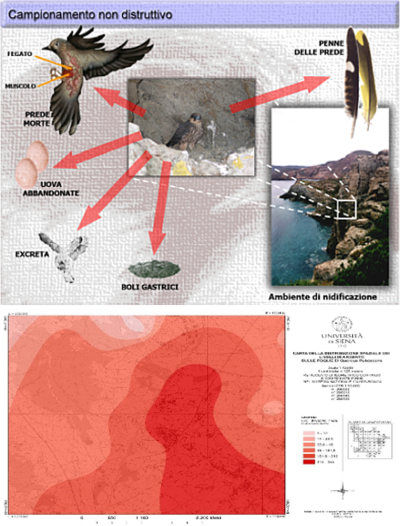
Trace element biomonitoring in areas with different impacts (industrial, urban, agricultural, and natural)
The evaluation of trace elements bioaccumulated by both animals and plants is increasingly used as an investigation technique alongside traditional detection methodologies based on chemical-physical analysis in various environmental compartments. This approach allowing to detect spatial-temporal variations of contamination in areas subject to different types of impact such as industrial, urban, agricultural, mining and natural or remote areas.
Over the years, particular attention has been paid to toxic elements such as mercury (Hg), cadmium (Cd), and lead (Pb). However, other elements of ecotoxicological interest are also investigated including, of recent focus and research development, the Rare Earth Elements (REEs).
Plant organisms are also widely used for their ability to intercept and trap contaminants from atmospheric deposition, providing valuable information for studying this environmental compartment, implementing Geographic Information Systems, and producing specific cartographic documents.

Ecophysiology and ecotoxicology of trace elements in marine vertebrates
In order to cope with the naturally high levels of mercury of their diet (ichthyophages), some classes of marine vertebrate have evolved systems capable of maintaining the concentrations of free metal ions in their cells below certain limits such as to contain any damage. Physiological strategies implemented are: a regulated excretion, a specific system of transporters to ensure a proper distribution between internal organs, cells and intracellular compartments, and specific detoxification systems. Researches on these organisms allows to obtain information on the distribution of heavy metals in different ecosystems, in food webs, in different classes of vertebrates (Mammals, Birds, Fish), in specific biological structures, as well as on the physiological mechanisms that limit their excessive accumulation and/or toxic action.

The analytical methods used are based on atomic absorption and/or emission spectrometry, utilizing the instrumentation available at the Laboratory of Ecophysiology and Ecotoxicology of Trace Elements (Environmental Sciences section, via P.A. Mattioli, 4 Siena).
A specific attention is also paid to the methods for estimation of the bioavailability of the elements by evaluating the bioaccessibility through sequential extraction methods for sediments and through in vitro simulation of gastric-intestinal digestion methods for tissues and/or materials of the diet of specific organisms.
Over the years, various research projects and scientific collaborations on this subject led to various contributions to national and international conferences and journals, and provided opportunities of participation for many students during the preparation of their Degree Theses.