


The PhD is a postgraduate academic qualification, representing the highest level of university education within the Italian academic system. It has a duration of 3 years, and earning the degree is contingent upon acquiring 180 ECTS credits (60/year).
The program's objective is to train researchers with advanced skills in the multidisciplinary analysis of environmental systems, enabling them to develop innovative solutions for sustainable resource management and global environmental challenges. Activities are connected to the DSFTA laboratories, the Centre for Geotechnologies, the National Antarctic Museum, and other research centers with active agreements.
The training activities include classroom lectures, seminars, practical exercises, laboraty work and internships, basic research, and research aimed at specific thesis projects.
A strong emphasis on shared first-year training activities is followed by a progressive differentiation of the educational offerings in the subsequent two years. This leads to training paths increasingly focused on the PhD students' individual research experiences, their involvement in specific laboratory and field activities, stays abroad, and internships at universities and public research institutions. As they acquire and process their initial research results, PhD students are encouraged to prepare scientific publications and participate in conferences and workshops.
The teaching activities for "STAGP" PhD students are divided into:
- Activities conducted at the University of Siena facilities and at the premises of partner research institutions across Italy;
- Activities carried out abroad (all PhD students are required to spend at least six months abroad at a university or other foreign institution, in line with the University of Siena's priority objectives for internationalization).
Soft Skills
University of Siena offers a wide range of courses (soft skills), organized into single modules or series of lessons. These courses aim to foster the acquisition of knowledge on systems for valorizing research results, disseminating findings, protecting intellectual property, and understanding the ethical implications of research.
It's possible to delve into cross-cutting topics like sustainability and develop personal abilities such as public communication. Furthermore, these training pathways prepare students for participation in European funding programs, offer an important opportunity for reflection on the doctoral journey, and help in planning their post-doc future. [link to soft skills page]
Right after enrollment, each PhD student, along with their tutor and co-tutor, will establish their Training Project. This project includes:
- individual research program;
- a list didactic activities that are complementary to research activities, with third-level courses and seminars (potentially supplemented with second-level courses, and in rare cases, first-level courses) that will form personalized study plan.
Study PlanTo obtain the title of PhD, each candidate must achieve 180 credits (European Credit Transfer and Accumulation System - ECTS) over the three years of the course (60 credits/year), divided as follows:
1st Year (60 ECTS)
- Research activities related to the thesis project: 35 ECTS
- Training activities: 25 ECTS
- Total: 60 ECTS (Credit recognition, final judgment: Approved)
2nd Year (60 ECTS)
- Research activities related to the thesis project: 40 ECTS
- Training activities: 20 ECTS
- Total: 60 ECTS (Credit recognition, final judgment: Approved)
3rd Year (60 ECTS)
- Research activities related to the thesis project: 45 ECTS
- Training activities: 15 ECTS
- Total: 60 ECTS (Credit recognition, final judgment: Approved)
In addition to core training and research, PhD students are encouraged to engage in other activities. These include "third mission" initiatives, such as the European Researchers' Night, and teaching activities. Examples are tutoring for bachelor's degree programs, co-supervising master's theses, and assisting with laboratory exercises or educational excursions.
For tutoring, supplementary teaching, and third mission activities, certification from tutor is required and must be attached to annual final report.
At the end of each year, PhD students must submit a report on their research activities (countersigned by their academic tutor). They'll also engage in a public discussion covering the most relevant aspects of their work, achieved results, and a general plan for the following year's activities. Progression to the next academic year depends on the Academic Board's assessment of the research work completed and the student's participation in didactic and training activities. Annually, the Academic Board organizes series of seminars and short theoretical-practical courses taught by Italian and international experts, which PhD students must attend.
Essential Requirements for Progression and Degree Attainment (from the 39th cycle onwards):
- Create an ORCID (Open Researcher and Contributor ID) profile and link it to other database profiles, such as Scopus and ISI WEB (required for admission to the second year).
- Complete and submit the PhD student opinion survey (required for admission to the second and third year).
- Participate in person in training initiatives (seminars, etc.) organized by the PhD program (required for admission to the second and third year).
- Participate in person in the PhD students' discussion days (required for admission to the second and third year).
- Have at least two scientific publications (one published and one accepted) during the PhD period, clearly demonstrating the candidate's contribution (as first or last author; corresponding author).
- Complete and submit the AlmaLaurea questionnaire: This must be done by the end of your studies, and the completion receipt must be submitted along with your final report on activities carried out.
For Admission to Final Examination:
One month before the end of the three-year period, and with your tutor's favorable opinion, you'll submit a request to the Academic Board for admission to the final examination. This request must include a final report on activities and thesis (in Italian or English; other languages require prior authorization from the Academic Board), along with a summary in Italian or English. [Instructions for final examination]
| n. | CORSO | DOCENTE | METODI DI INSEGNAMENTO | PERIODO | CFU | |
| 1 | Analisi granulometriche per matrici goelogiche ed ambientali | Ivan Martini |
Lezioni in aula e laboratorio (lingua italiana) |
17 e 18 novembre 2025 – (9:00 -13:00) |
2 | I anno |
| 2 | Fondamenti di microscopia elettronica | Cecilia Viti/Narcisa Mihaela Marian |
Lezioni in aula e laboratorio (lingua italiana) |
18 febbraio 2026 (09:00 – 13:00 teoria) e (14:00 – 16:00 laboratorio), 19 febbraio 2026 (09:00 – 13:00 laboratorio) | 3 | I anno |
| 3 | Tecnologie Biochimiche per la Sostenibilità Ambientale | Paola Albanese |
Lezioni in aula e laboratorio (lingua inglese) |
3 e 5 febbraio 2026 (10:00-13:00), 11 febbraio 2026 (10:00-13:00) e Lab. (14:00-18:30), lab.13 febbraio 2026 (14:00-18:30) | 6 | I anno |
| 4 | Biological and synthetic approaches in advancing RNA delivery design | Ester Canepa/Ilaria corsi |
Lezioni in aula (lingua inglese) |
2 dicembre 2025 (14:00-17:00), 3 dicembre 2025 (10:00-13:00) | 1,5 | I anno |
| 5 | Piante medicinali e sostenibilità: dal tradizionale valore terapeutico alle nuove frontiere di impiego | Giulia Baini |
Lezioni in aula (lingua italiana) |
20 gennaio 2026 (14:00-18:00), 23 gennaio 2026 (14:00-18:00) | 2 | I anno |
| 6 | Footprint Framework for Sustainability: Beyond Carbon Metric | Valentina Niccolucci |
Lezioni in aula (lingua italiana) |
14, 15, 21, 22 aprile 2026 (14:00 – 17:00) | 4 | I anno |
| 7 | Fotogrammetria da drone | Riccardo Salvini | Lezioni in aula, esercitazioni pratiche e al PC | 1,2,3 ottobre 2025 | 6 | II anno |
| 8 | National Biodiversity Future Center. Contaminanti emergenti ed impatto sulla biodiversità marina | Maria Cristina Fossi/Ilaria Corsi/Cristina Panti/Matteo Baini/Arianna Bellingeri/Giacomo Limonta | Lezioni in aula | 24, 25 marzo 2026 | 5 | II anno |
| 9 | Data analysis of multivariate observations | Dario Albarello | Lezioni in aula | 3, 4 febbraio 2026 | 2 | II anno |
| 10 | Mineral resources and critical raw materials: sustainable mining, recovery and environmental safety | Cecilia Viti/Ilaria Corsi/Arianna Belingeri/Narcisa Mihaela Marian | Lezioni in aula | da definire | 4 | II anno |
| 11 | Cicli astronomici e stratigrafia integrata | Luca Maria Foresi | Lezioni in aula, esercitazioni con sw specifici per analisi di segnale | 4, 5, 10, 12, 16, 17 dicembre 2025 | 4 | III anno |
Annually, for first and second-year PhD students, a scientific results presentation day is organized. This provides an opportunity for them to interact with each other and with the faculty, receiving valuable feedback for their ongoing activities. For newly enrolled students, there's a day dedicated to presenting their projects.
Starting from the 41st cycle, the currently running events will be renamed as follows:
- A PhD Welcome Day: New Beginnings and Research Visions, held annually, where newly enrolled students introduce themselves and their PhD projects – December 2, 2025.
- A PhD Progress Day: Milestones and Results of Ongoing Research, held annually, where students who have completed their first and second years present the status and results of their thesis work – October 27, 2025, begins at 9:30 Aula Magna in Pian dei Mantellini.
Beginning with the 41st cycle, we're also launching Cocktail Day: Sipping Science. This additional collective day is designed to encourage integration among PhD students from different cycles and to foster cultural exchange, with the participation of students from the DSFTA's degree programs – February 13, 2026.
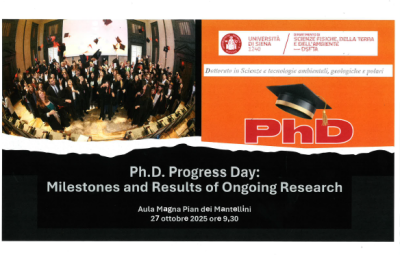
PhD Progress Day: Milestones and Results of Ongoing Research
lunedì 27 ottobre 2025 - ore 9:30 presso l’Aula Magna di Pian dei Mantellini
Day dedicated to the presentation of research projects by PhD students of the Doctoral Course in Environmental, Geological, and Polar Sciences and Technologies.
All members of the DSFTA scientific community—faculty, technical staff, researchers, research fellows, and Doctors of Research—are invited to participate to value the work of young researchers, foster the exchange of ideas, and stimulate a shared reflection on ongoing research paths.
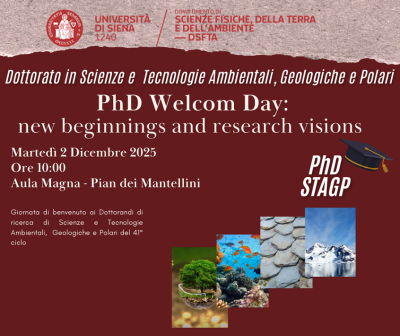
PhD Welcome Day: New Beginnings and Research Visions
Martedì 2 dicembre 2025 alle ore 10:00 presso l’Aula Magna di Pian dei Mantellini.
It will be an opportunity to welcome the newly enrolled PhD students of the 41st cycle and to hear and discuss their training projects and the research visions that will guide their academic path.
The meeting represents a fundamental moment of integration and discussion for the scientific community of the University of Siena.
All members of the DSFTA scientific community—faculty, technical staff, researchers, research fellows, and Doctors of Research—are invited to participate to support and encourage the new members of the doctoral community.
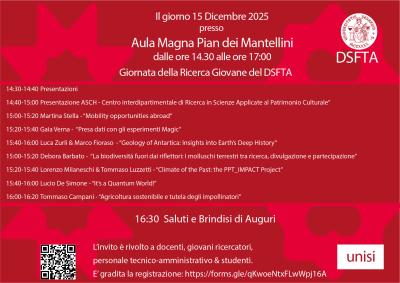
Giornata della Ricerca Giovane del DSFTA
Monday, December 15, 2025 Time: 2:30 PM – 5:00 PM Location: Aula Magna Pian dei Mantellini
The day is designed to be an opportunity for networking, discussing ideas and perspectives on research, discovering the activities of our young researchers, and finally exchanging well wishes for the upcoming holidays. The event is open to the entire DSFTA community.
In order to best organize the event, we ask you to confirm your attendance by registering via the link: https://forms.gle/qKwoeNtxFLwWpj16A or through the QR code shown on the poster.